Alabaster has moved from a niche material used by a handful of European ateliers into the mainstream of hotel specification. Walk through any design show in 2026 and you will see the same warm, softly glowing stone on lobby walls, corridor runs and bedside positions. For specifiers, the appeal is obvious: alabaster does something no glass or fabric shade can do — it turns the light source itself into a surface, so the fixture reads as a solid object by day and a lamp by night.
But alabaster is also the least standardised material in decorative lighting. There is no grade chart, no universal thickness, and two “identical” sconces from different suppliers can look like different products. This guide is written for the person who has to specify it, budget it, and defend the choice when the first shipment arrives with visible veining differences.
What alabaster actually is — and what it is not
Alabaster is a soft, translucent stone, most often a fine-grained gypsum. The material used in quality hospitality fixtures is typically Spanish alabaster, quarried in the Ebro Valley, chosen for its even grain and high translucency. It is soft enough to be cut and turned on conventional stone-working equipment, which is why it can be produced at volume rather than only by hand carvers.
Two confusions cost specifiers real money:
- Alabaster is not marble. Marble is a metamorphic carbonate and is essentially opaque at shade thickness. If a supplier describes a product as “alabaster marble”, ask for a translucency test — backlight a sample. A true alabaster shade glows; a marble shade does not.
- Alabaster is not onyx. Onyx is a banded calcite, harder and more vividly veined. It is beautiful and considerably more expensive. Onyx is often the right choice for a single statement piece; alabaster is the right choice when you need forty sconces down a corridor and want them to read as a set.
The practical consequence of alabaster being gypsum: it is soft (around 2 on the Mohs scale), it is porous, and it is soluble in water over time. All three facts should shape your specification.
Why hospitality has adopted it now
Three things happened at once. LED modules became small and cool enough to sit inside a stone shade without cooking it. Warm-dim drivers reached the point where a stone fixture can dim to 2200K without colour shift, which is exactly the behaviour designers want in a lobby at 22:00. And the broader move towards natural, tactile materials — the same current that pushed travertine, lime plaster and unlacquered brass back into hotel interiors — created demand for a lighting material with the same character.
Trend-wise, alabaster is not a one-season finish. It sits inside a longer shift towards materials that patinate rather than stay inert, which is why we treat it as a 2027 core material rather than an accent. For a wider view of where hospitality lighting is heading, see our layered design guide for boutique hotels.
The specifier’s checklist
1. Translucency and wall thickness
This is the single variable that determines whether the fixture looks expensive or looks like plastic. Thin walls (6–8 mm) glow brightly and read as luminous, but they also telegraph the LED source and can show hot spots. Thicker walls (10–14 mm) glow more softly and evenly, hide the source completely, and feel substantial — but they are heavier and cost more in both material and freight.
Ask the supplier for the wall thickness in millimetres, in writing, and ask for a lit sample photograph taken in a dark room. A supplier who cannot tell you the thickness is buying shades on price, not on spec.
2. Veining and batch matching
Alabaster is a natural stone; every block is different. Veining ranges from almost white and uniform to pronounced honey-brown banding. For a corridor run of thirty sconces, you must specify a veining grade and require batch matching — shades cut from adjacent blocks so the run reads consistently.
This is the most common failure point in alabaster projects. The first sample is beautiful; the production batch is noticeably browner. Insist on a production sample from the actual block before the full run is cut, and write the approved sample into the order.
3. LED source, wattage and colour temperature
Stone shades run warm by nature, so a 4000K source behind alabaster will still read warm — but a 2700K source behind it reads golden in a way most designers want for guest-facing areas. Standard practice:
- Guest rooms and bedside: 2700K, 4–6 W per shade, dimmable. You want glow, not illumination.
- Corridors: 2700–3000K, 6–9 W, on a dimming schedule for night-time.
- Lobbies and reception: 3000K for the ambient layer, and accept that alabaster is a decorative layer, not a task layer. Pair it with separate downlights for actual illuminance.
Because alabaster is a poor conductor and shades are often enclosed, check that the manufacturer has thermal-tested the assembly. An LED rated for 40,000 hours in open air can drop to a fraction of that in a sealed stone housing.
4. Weight and fixing
A large alabaster shade is heavy — a three-tier lobby chandelier can easily exceed the weight the equivalent glass fixture would. Two consequences: your ceiling or wall substrate must be confirmed before order, and the fixing detail (a brass backplate, a concealed cleat, or a rod suspension) has to be specified at the same time as the fixture, not on site.
For high or vaulted spaces this interacts directly with structural sizing; our guide to chandelier sizing and engineering for high ceilings covers the load and suspension questions in detail.
5. Finish pairing
Unlacquered and satin brass is the default pairing, and for good reason: brass picks up the warm tone of the stone rather than fighting it. Antique bronze works with heavily veined alabaster. Polished chrome tends to look clinical against the softness of the stone and is usually the weakest pairing. If your project already has a specified metal finish, send it to the factory — brass tone varies between suppliers and a mismatch here is very visible.
6. Sealing and cleaning
Alabaster is porous and water-soluble. Unsealed, it will mark from fingerprints and will dull if wiped with a wet cloth. Specify a penetrating sealer applied after final polishing, and write the cleaning instruction into the handover documentation: dry microfibre only, no solvents, no wet wiping.
This is a genuine operational issue for hotels — housekeeping teams will clean a stone sconce the way they clean everything else unless they are told otherwise. Budget for a spare shade or two per floor; alabaster chips rather than dents, and a chipped shade is a replacement, not a repair.
Where alabaster works — and where it does not
Corridors — the strongest application
Corridors are where alabaster earns its cost. A run of wall sconces at 1400–1600 mm centre height, spaced 2.5–3 m apart, gives even ambient light with no glare at eye level and turns a dead corridor into a designed one. Because the fixture count is high, this is also where batch matching matters most.
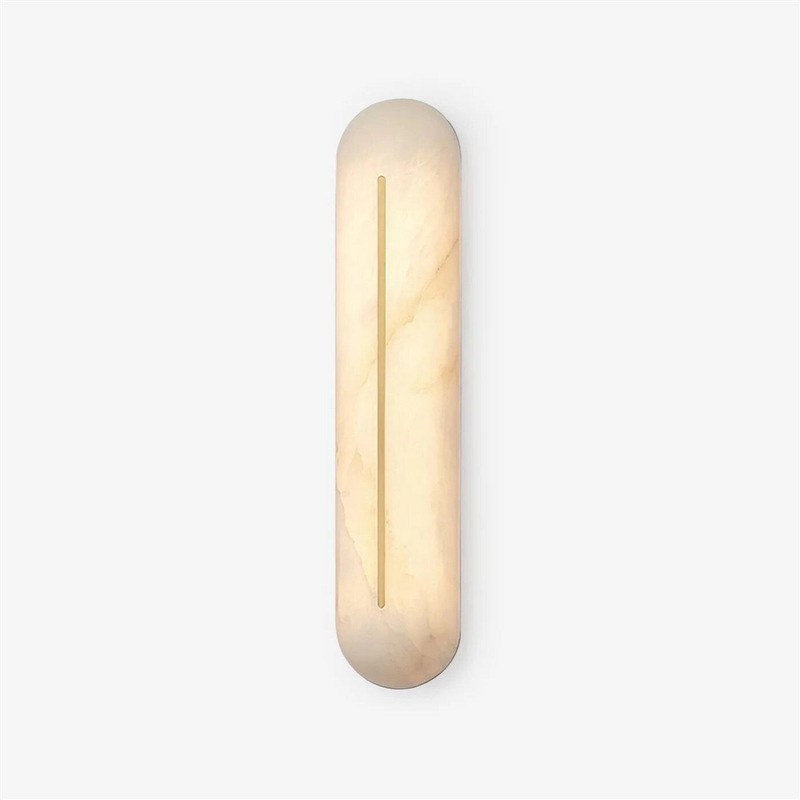
Vertical formats work best in circulation: a slim vertical capsule sconce or a ribbed vertical bar sconce reads as an architectural element rather than a lamp. For feature walls, a stacked cube sconce gives more sculptural presence.
Guest rooms — bedside and reading positions
Alabaster is ideal at bedside: soft, warm, no glare when you are lying down. Mount shades so the bottom of the fixture sits roughly 1200–1400 mm above the floor for a bedside reading position. A brass U-bracket sconce with an oval shade is the classic detail; a twin-shade sconce suits twin and double-occupancy rooms where both sides need light.
Lobbies — decorative layer only
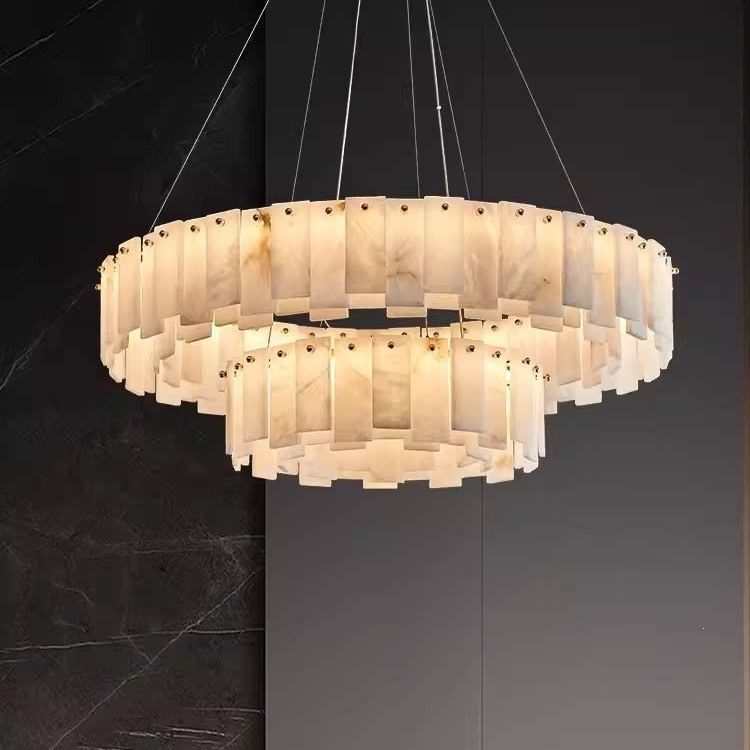
In a lobby, alabaster is the decorative layer, never the whole lighting scheme. A three-tier alabaster drum chandelier provides presence and a warm ambient wash, but the space still needs recessed downlights for circulation illuminance and accent lighting for the reception desk. Pair large alabaster pendants with a matching bowl sconce on the perimeter walls to tie the scheme together.
Restaurants and bars
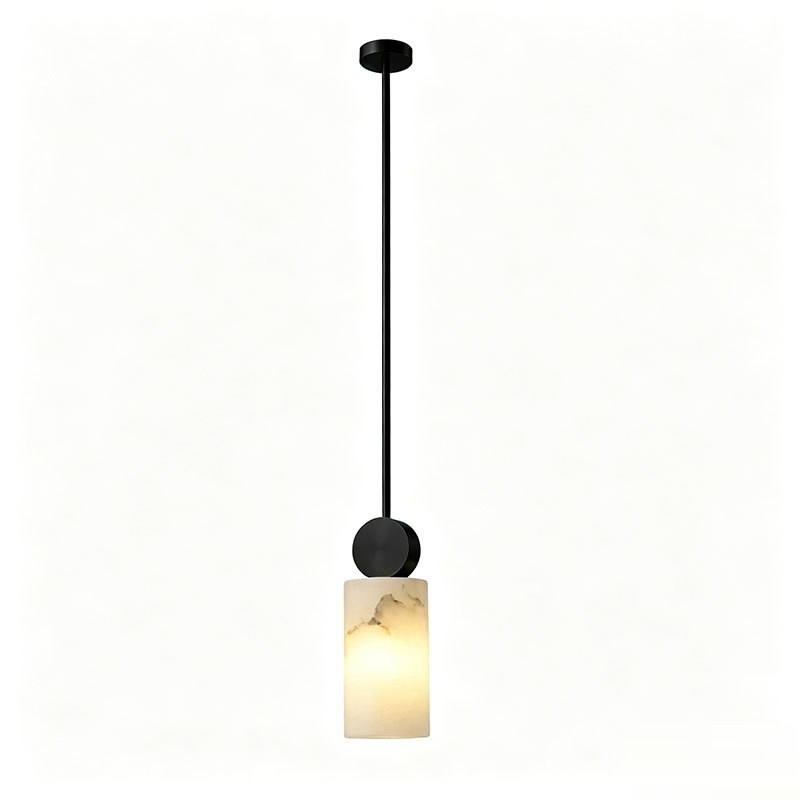
Over tables and bars, alabaster gives the low, warm pool of light that makes a room feel intimate. A slim-rod cube pendant over a bar counter or a row above a banquette works well at 2700K on a dimmer. Keep it away from kitchen-adjacent areas where grease and steam will mark unsealed stone.
Where to avoid it
Wet areas, spa changing rooms, poolside and any exterior position — alabaster is water-soluble and will not survive. High-traffic areas within arm’s reach of luggage and trolleys are also a poor choice, because the stone chips.
Specifying custom alabaster: what to send the factory
Alabaster is unusually well suited to custom work, because the stone is cut to order anyway. Sizes, tier counts and shade profiles can usually be changed without tooling — which is very different from glass or metal, where a new shape means a new mould.
To get an accurate quote and a usable sample, send: overall dimensions and a dimensioned sketch; the application and mounting surface; quantity per size; target colour temperature and dimming protocol; the metal finish, with a reference if you have one; the veining grade you want; and the delivery port or Incoterm.
Our guide to briefing your lighting factory covers this in more depth, and OEM lighting manufacturing: from your drawing to production walks through what happens to your drawing once the factory receives it.
What it costs, and what drives the cost
Three variables dominate the price of an alabaster fixture, in this order:
- Stone volume. Alabaster is priced by weight, so a large or thick-walled shade is materially more expensive than a small one. This is the main reason a three-tier lobby piece costs multiples of a corridor sconce.
- Finish and metal work. Solid brass backplates and brackets cost significantly more than plated steel. On long runs this is the largest single line item after the stone.
- Veining grade and matching. Uniform, lightly veined stone is scarcer and more expensive than heavily banded material. Batch matching across a large run adds labour.
Custom sizes usually carry little or no tooling cost in alabaster — a real advantage over glass or metal. For how MOQ, lead time and Incoterms interact on a project order, see our practical guide to importing lighting from China.
On compliance, alabaster fixtures follow the same rules as any other luminaire: the assembly, not the stone, is what gets certified. Check the CE, UL and RoHS documentation for the complete fixture — our breakdown of what OEM buyers must check in certificates explains what to look for.
Frequently asked questions
Is alabaster lighting durable enough for a hotel?
Yes, with two conditions: the shade is sealed after polishing, and housekeeping is told to clean it dry. Sealed alabaster in a corridor or guest room will last the life of the interior. It is not suitable for wet areas, and it chips rather than dents if struck — so avoid positions within reach of luggage trolleys and specify a few spare shades.
Why do alabaster shades from the same order look different?
Because alabaster is a natural stone and every block varies in veining and tone. This is normal and is part of the material’s appeal, but it must be managed: specify a veining grade, require batch matching so a run is cut from adjacent blocks, and approve a production sample from the actual block before the full run is cut.
What colour temperature works best behind alabaster?
2700K for guest rooms, bedside positions and restaurants, where you want a golden glow. 3000K for lobbies and circulation, where the stone is a decorative layer over separate ambient lighting. Alabaster warms whatever is behind it, so a 4000K source will still read warm — but for hospitality it rarely looks right.
Can alabaster fixtures be made in custom sizes?
Yes, and more easily than glass or metal. Because the stone is cut to order, changing the diameter, height or number of tiers usually requires no mould or tooling. Send a dimensioned sketch with quantity, finish, colour temperature and mounting surface, and the factory can quote directly.
How do you clean alabaster lighting?
Dry microfibre cloth only. Alabaster is a porous, water-soluble gypsum, so water, solvents and household sprays will dull or mark the surface even on a sealed shade. Write this into the housekeeping handover documentation — it is the single most common cause of premature damage in hotels.
Is alabaster heavier than glass?
Comparable to somewhat heavier at equal size, and noticeably heavier on large multi-tier pieces. Always confirm the ceiling or wall substrate and specify the fixing detail at the time of order, particularly for rod-suspended pendants and large lobby chandeliers.
Bottom line for specifiers
Alabaster is a 2027 core material for hospitality, not a passing finish, and it is one of the few decorative materials where custom sizing does not trigger tooling cost. Specify it properly — wall thickness in writing, veining grade agreed, production sample approved, sealer confirmed, and the metal finish referenced — and it will outperform glass on both look and longevity.
If you are selecting a lobby chandelier more broadly, our guide on how to choose a chandelier for a boutique hotel covers sizing, proportion and the questions that apply to any hotel centrepiece.