CE, UL & RoHS Explained: What OEM Buyers Must Check in Certificates
When you source lighting for hotels, restaurants or retail projects, the conversation almost always arrives at the same three abbreviations: CE, UL and RoHS. They appear on datasheets, on product labels and in quotation annexes — yet for many OEM buyers they remain a source of quiet uncertainty. What does each marking actually cover? Who should hold the certificate? And how do you verify that a certificate presented to you is genuine, current and applicable to the fixture you are about to order? This guide answers those questions from the buyer’s side of the table, and explains how certification is handled in a real OEM lighting order.
Nothing in this article is legal advice, but it reflects the experience we have built since 2014, shipping lighting into eleven countries and answering exactly these questions from project buyers, importers and design firms. Get the basics right and certification stops being a gamble and becomes a routine line in your procurement checklist.
The Three Letters, Decoded
It helps to stop thinking of CE, UL and RoHS as one interchangeable bundle. They answer three different questions: is the product legally sellable here, is it independently listed for safety, and does it stay within material limits? Each has its own paperwork, its own authority and its own failure mode.
CE marking — the passport to the European market
The CE marking indicates that a product meets the applicable health, safety and environmental protection requirements of the European Union. For lighting, the directives that matter are the Low Voltage Directive (2014/35/EU) and the Electromagnetic Compatibility Directive (2014/30/EU), usually supported by harmonised standards such as EN 60598 for luminaires and EN 61347 for controlgear.
One point deserves emphasis: CE is a self-declared marking. The manufacturer or its authorised representative draws up a Declaration of Conformity backed by testing evidence. That does not make CE meaningless — it means the legal responsibility sits with whoever declares conformity, and the quality of the supporting test report is what you should inspect, not the sticker alone.
UL certification — the North American framework
Across the United States and Canada, most jurisdictions require luminaires to be listed by a nationally recognised testing laboratory. UL certification — along with its siblings cUL, ETL and CSA — is a third-party scheme in which an accredited laboratory evaluates the product against standards such as UL 1598 for luminaires and UL 8750 for LED equipment.
Unlike CE, UL certification is not a self-declaration. The laboratory tests the product, inspects the manufacturing process, and typically conducts follow-up visits. That is precisely why a UL certificate carries weight with inspectors, insurance companies and hotel chains in North America — and why it is one of the most requested documents in hospitality projects.
RoHS — restricting hazardous substances
RoHS limits the use of lead, mercury, cadmium, hexavalent chromium and other hazardous substances in electrical and electronic equipment. For lighting, the two versions exporters encounter most are EU RoHS (Directive 2011/65/EU) and the China RoHS regime. Compliance is normally demonstrated by a test report from an accredited laboratory covering the restricted substances, and it becomes part of the technical file that backs the CE declaration.
CCC and UKCA — know your destination market
Certification does not end at CE and UL. CCC (China Compulsory Certification) applies to electrical products sold in the Chinese market, and UKCA is the conformity framework for Great Britain after Brexit. The practical conclusion is simple: certification is not one document but a set of requirements that changes with the destination market. A fixture certified for Europe is not automatically certified for North America, and vice versa.
Why Certificate Ownership Is the First Question
The most valuable question you can ask a supplier is not “Do you have CE?” but “Who holds the certificate?” A certificate issued to a trading company has limited value when authorities, inspectors or hotel chains audit the shipment. What they want to see is a clear chain: a certificate held by the entity responsible for manufacturing the goods, or documentation that clearly ties the supplying company to that holder.
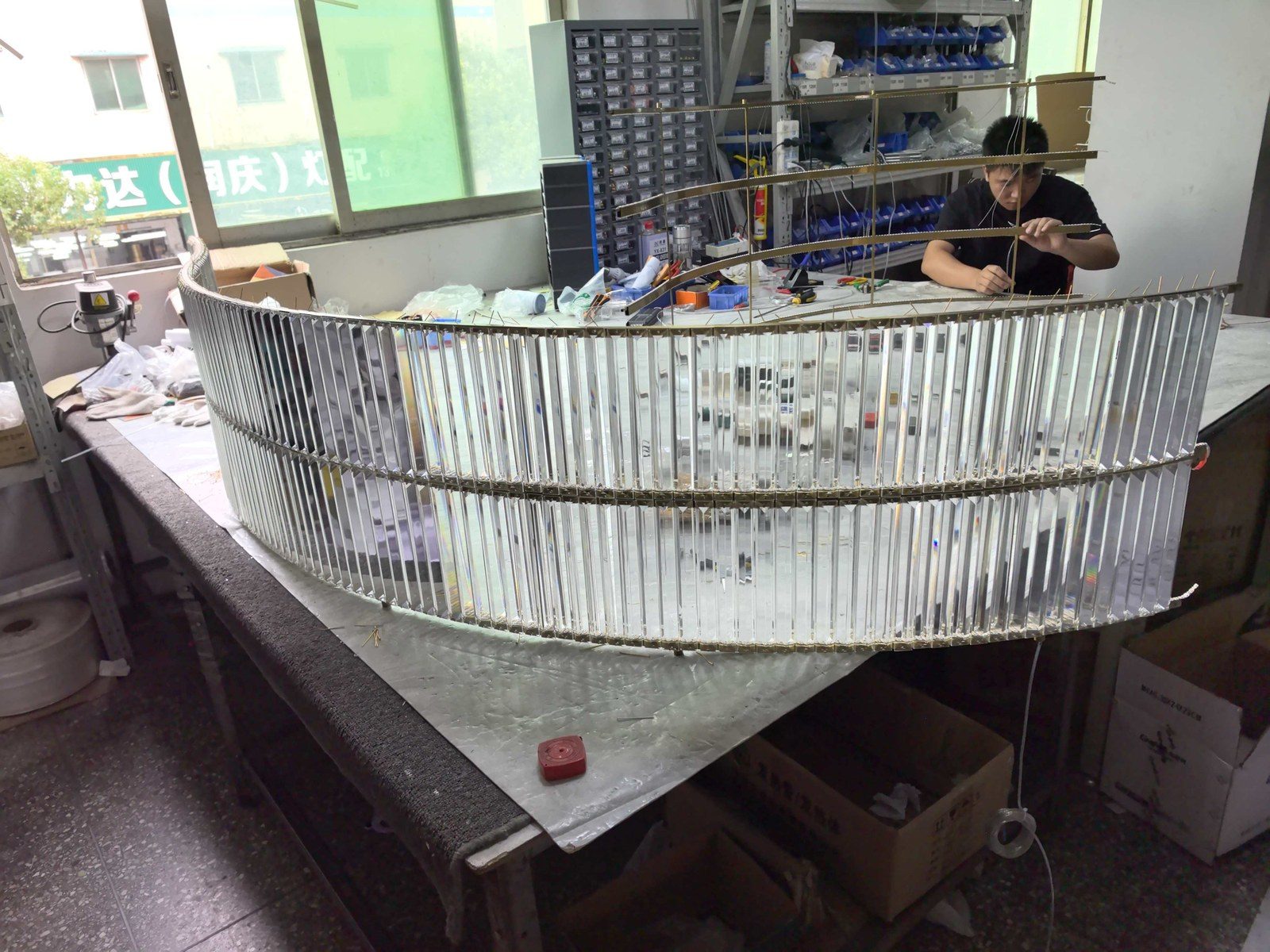
This is where the sourcing model matters. Staylighting works as a sourcing partner with long-term partner factories and specialist subcontractors; every fixture is assembled, tested and packed at our facility in Zhongshan. Certification is arranged per order according to the destination market — CE, UL, CCC, RoHS or UKCA — and quoted as a separate line item, so you know exactly what you are receiving and what it costs. If you want the full picture of how that arrangement works in practice, our certification policy and our factory page describe the setup in more detail.
What to Verify Before You Accept a Certificate
Certificates look impressive on paper. Before you file one away, run through this six-point check:
1. The certificate holder matches your supplier chain. If the certificate names a company you have never heard of, ask for the relationship explained in writing — a license agreement, a manufacturing agreement or a letter of authorisation.
2. The standard version and date are current. Directives and standards are revised. A certificate citing a withdrawn edition of EN 60598 or an old UL standard is a red flag, not a formality.
3. The model or series covers your fixture. The certificate should list the exact model or model family you are buying. A certificate for a different fixture is worth very little.
4. The testing laboratory is accredited and traceable. Look for a report reference and a laboratory you can actually verify — TÜV, SGS, Intertek, DEKRA, UL and similar bodies publish databases where you can check certificate numbers.
5. The marking on the physical product matches. The label on the fixture — logo, control number, date code — should be consistent with the certificate. Mismatches here are the classic failure found in customs or site inspections.
6. The scope is honest. Some certificates cover electrical safety only; others include photobiological safety (LED blue-light), EMC or environmental provisions. Know which scope your project actually needs before you sign the order.
How Certification Works in an OEM Order
In a well-run OEM order, certification is never an afterthought discovered at the shipping stage. It runs through the process from the first enquiry:
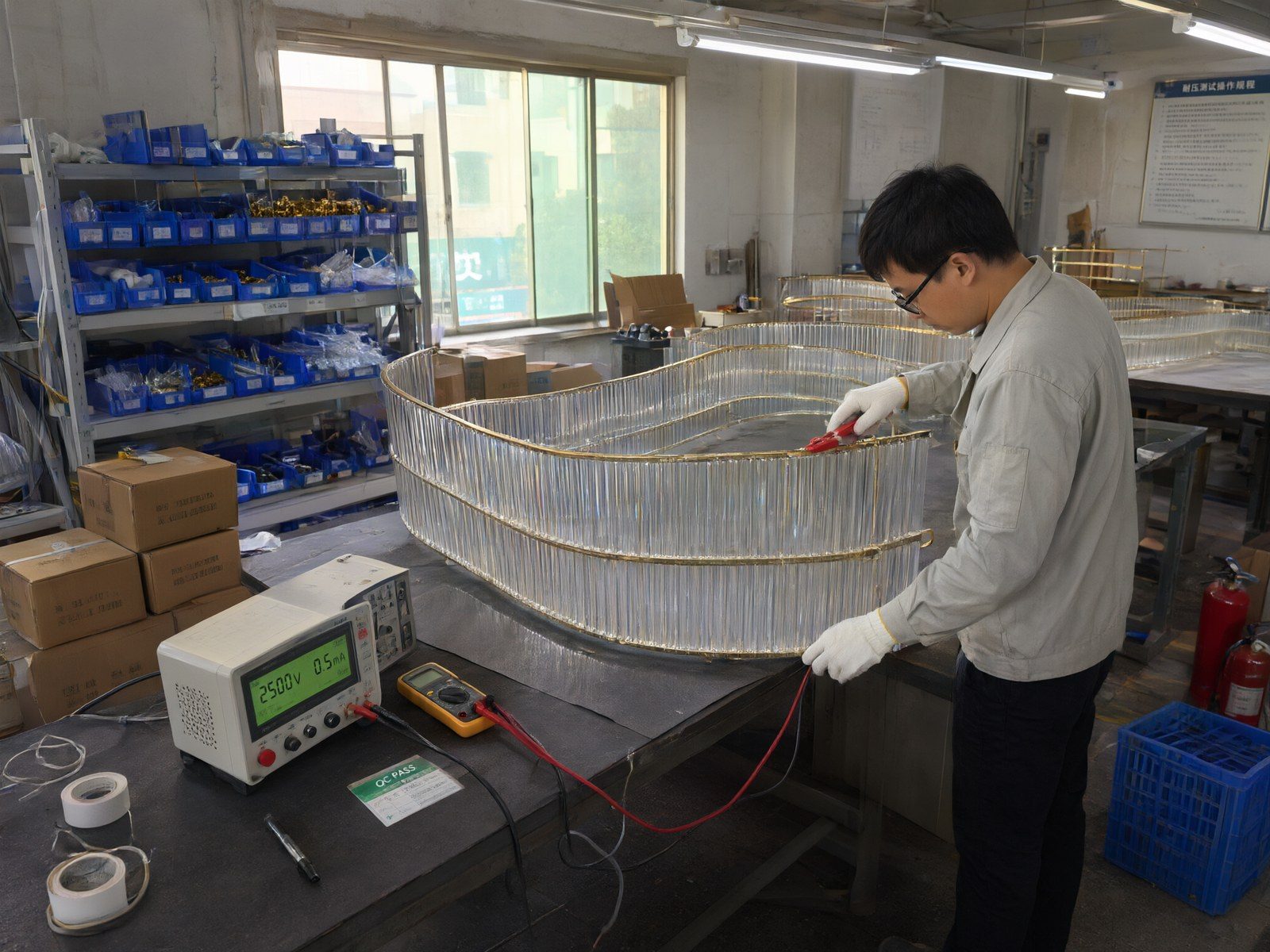
Step 1 — State the destination market. The moment you tell us the end markets, we flag which markings apply. Europe points to CE, North America to UL or cUL, Great Britain to UKCA, China to CCC.
Step 2 — Quotation with certification as a separate line. Certification appears in the quotation as its own line item, so there are no surprises later. Existing coverage costs little; a new assessment for a non-standard fixture costs more, and you will see that before you commit.
Step 3 — Confirm at the sample stage. When we produce your sample — whether it is a catalogue design or a custom chandelier built from your drawings — the applicable certification requirements are confirmed against the actual construction and components.
Step 4 — Documents ship with the goods. The Declaration of Conformity, test reports and certificates are packed with the shipment or sent electronically ahead of customs clearance. For bespoke projects, our team coordinates the testing timeline with the production schedule so certification never holds up delivery.
The Mistakes OEM Buyers Make Most Often
Over the years we have watched buyers lose time and money on the same handful of errors. Avoid these and you are already ahead of most teams:
Accepting an expired standard edition. Check the issue date against the current directive or standard before you pay for re-testing later.
Confusing a CE declaration with third-party certification. CE is a declaration; UL is a listing. Treat them differently and ask for the supporting test evidence behind each.
Ignoring label consistency. The sticker on the product must match the certificate. Inspect one unit from the first batch, not just the paperwork.
Assuming one certificate covers every destination. EU, North America, UK and China each have their own frameworks. A fixture cannot be “CE, UL and CCC” by magic — each marking has to be arranged for that order.
Leaving certification out of the purchase order. If it is not written into the order, it is not guaranteed. Put the required markings and documents into the contract, and confirm the responsible party.
Certification is also easier to plan when the fixture itself is simple to document. Integrated LED modules with replaceable drivers — as on the alabaster cube pendant, the slim alabaster capsule sconce and the brass picture light — are the least complicated to re-test and re-mark for a new destination market.
Frequently Asked Questions
Does Staylighting provide CE, UL and RoHS certificates with every order?
Certification is arranged per order according to the destination market and quoted as a separate line item. When the order includes a certification requirement, the matching documentation — Declaration of Conformity, test reports and certificates — is provided with the shipment.
Can you certify a custom-made fixture for the US or EU market?
Yes. Because we assemble, test and pack every fixture at our facility and coordinate with accredited laboratories, a custom design can be assessed against UL or CE requirements as part of the order process. The timeline depends on whether the construction can be covered by existing test evidence or needs a new assessment.
How much time does certification add to lead time?
If existing coverage applies, certification adds little or nothing to the schedule. Where a new assessment is required, testing typically adds a few weeks; we confirm the exact impact at the quotation stage so the production plan accounts for it.
Who is the certificate holder for custom fixtures?
It depends on the arrangement for that order. Our standard practice is to arrange certification through the responsible manufacturing chain, with the documentation clearly tied to your purchase. Ask us about your specific market and we will explain exactly what the certificate will show.
What should I send to get a certification quotation?
A product reference or drawing, the destination market or markets, and an indication of volume. We will confirm which markings apply and what each one adds to the quotation — transparent, before you commit. And if you are planning a project-scale order, the modern-luxury crystal chandelier collection shows how certified, custom-built designs come together for hotels and banquet halls.